
General Information
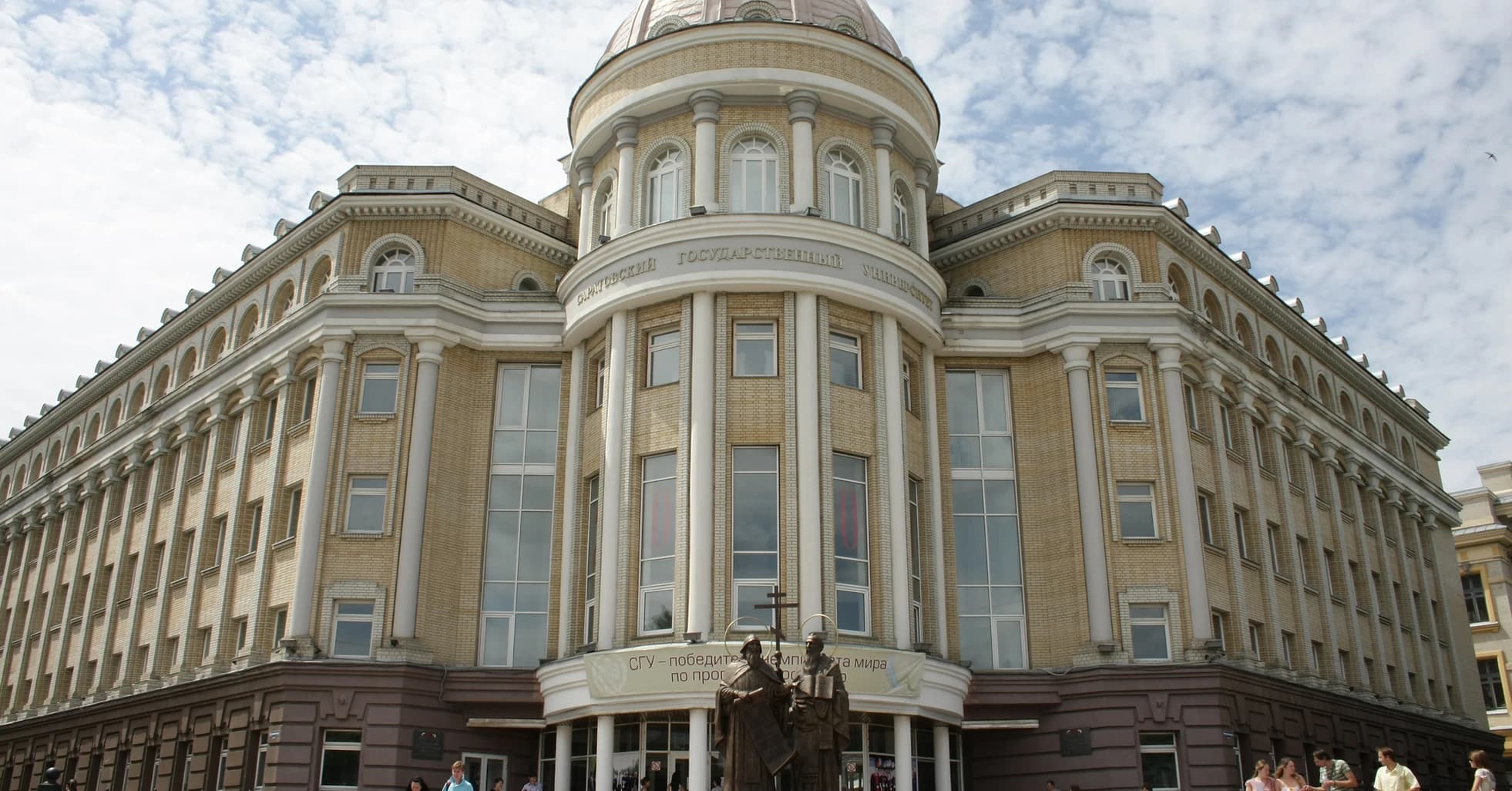
Saratov State Medical University, recognised by the World Health Organization (WHO), is a large and respected medical research centre in Russia, founded in 1909.
The university consists of 9 faculties: Faculty of General Medicine, Faculty of Dentistry, Faculty of Pharmacy, Faculty of Medical Prophylaxis, Faculty of Pediatrics, Faculty of Clinical Psychology, Department of International Students, Institute of Advanced Medical Education and Continuing Education, and Institute of Nursing. And these faculties have 7000 students from 50 countries, taught by 817 professors in 70 departments.
After graduating from the university, graduates receive a state-recognised diploma stating their higher education, the degree/qualification and the specialisation. If necessary, a graduate can obtain a Diploma Supplement, which makes it possible to obtain diploma equivalence in any country in the world for continuing education or employment, and to obtain equivalence for further study or employment in foreign countries.
SARATOV STATE UNIVERSITY PROGRAMMES
| Tourism | 4 Years | Russian | Bachelor’s |
| Tourism | 2 Years | Russian | Master’s |
| World Economy | 2 Years | Russian | Master’s |
| Medicine | 6 Years | Russian | Bachelor’s |
| International Trade | 2 Years | Russian | Master’s |
| International Trade | 4 Years | Russian | Bachelor’s |
| Preparatory Year | 1 Year | Russian | Bachelor’s |
| Dentistry | 5 Years | Russian | Bachelor’s |
| Biology | 4 Years | Russian | Bachelor’s |
| Public Administration | 2 Years | Russian | Master’s |
| Public Administration | 4 Years | Russian | Bachelor’s |
| Russian Language and Literature | 2 Years | Russian | Master’s |
| Law | 4 Years | Russian | Bachelor’s |
| Law | 2 Years | English | Master’s |
| Law | 2 Years | Russian | Master’s |
| Nursing | 4 Years | Russian | Bachelor’s |
| Economics | 4 Years | English | Bachelor’s |
| Economics | 4 Years | Russian | Bachelor’s |
| Economics | 2 Years | Russian | Master’s |
| International Business | 4 Years | Russian | Bachelor’s |
| Graphic Design | 2 Years | Russian | Master’s |
| Graphic Design | 4 Years | Russian | Bachelor’s |
| Philosophy | 4 Years | Russian | Bachelor’s |
| Philosophy | 2 Years | Russian | Master’s |
| Physics | 4 Years | Russian | Bachelor’s |
| Linguistics | 4 Years | Russian | Bachelor’s |
| Business Administration | 4 Years | Russian | Bachelor’s |
| Business Administration | 2 Years | Russian | Master’s |
| Journalism | 2 Years | Russian | Master’s |
| Journalism | 4 Years | Russian | Bachelor’s |
| Chemistry | 4 Years | Russian | Bachelor’s |
| Chemistry | 2 Years | Russian | Master’s |
| Mathematics | 2 Years | Russian | Master’s |
| Psychology | 4 Years | Russian | Bachelor’s |
| Psychology | 2 Years | Russian | Master’s |
| Islamic Studies | 4 Years | Russian | Bachelor’s |
| Political Science | 4 Years | Russian | Bachelor’s |
| Sociology | 2 Years | Russian | Master’s |
| Sociology | 4 Years | Russian | Bachelor’s |
| History | 2 Years | Russian | Master’s |
| History | 4 Years | Russian | Bachelor’s |
| Fine Arts | 4 Years | Russian | Bachelor’s |
| Fine Arts | 2 Years | Russian | Master’s |
| Conservatory | 4 Years | Russian | Bachelor’s |
| Liberal Arts and Sciences | 4 Years | Russian | Bachelor’s |
| International Relations | 4 Years | Russian | Bachelor’s |
| International Relations | 4 Years | English | Bachelor’s |
| International Relations | 2 Years | English | Master’s |
| International Relations | 2 Years | Russian | Master’s |
| International Law | 4 Years | Russian | Bachelor’s |
| Advertising and Public Relations | 4 Years | Russian | Bachelor’s |
| Advertising and Public Relations | 2 Years | Russian | Master’s |
| World Politics | 2 Years | Russian | Master’s |
ADMISSION REQUIREMENTS
Standard documents are required, such as the application form, a photocopy of your passport, a notarised Russian translation of your passport, and the diplomas and transcripts of your previous education. If the programme you are applying to is taught in English, you must document your language proficiency. If you will study in Russian, you must either prove your language proficiency or choose either the Russian preparatory year or the Foundation option.
Russian Preparatory Year
Students who want to study in one of the programmes taught in Russian can apply to the school without language proficiency. Depending on your Russian language level, you can enrol in the preparatory programme. At the end of the nine-month preparatory programme, they can obtain their language certificates and begin their programme.
LIVING CONDITIONS IN RUSSIA
Because Russia has a vast geography, the most preferred means of transport for intercity travel have been air and rail. Across Russia, the road, rail, air and metro networks are quite well developed, and it is possible to travel easily from one end of the country to the other. For urban transport, public transport such as trams, buses, trolleybuses and minibuses is used. In Russia, which has one of the best railway systems in the world, vehicles such as trams and the metro are among the most comfortable options for getting around. As with almost everything in Russia, transport costs are also quite low. Students can comfortably get around with a monthly pass costing 30 Lira. A single-journey ticket costs around 1 Lira.
ACCOMMODATION INFORMATION
Accommodation – Arranging accommodation is very important when planning to study abroad. Taking our students’ requests, preferences and sensitivities on this subject into account, we provide solutions in coordination with our partner schools. The accommodation options offered to students who want to study abroad are generally as follows.
ACCOMMODATION AND STUDENT DORMITORIES
There are dormitory facilities on the university campus. In addition, students can rent an apartment or a room at affordable prices close to the university.
SCHOLARSHIP OPPORTUNITIES
Candidate students have two options for studying in Russia on a scholarship. The first of these is the scholarships awarded by the Republic of Türkiye. Students can obtain detailed information on this from the provincial and district directorates of national education.
YÖK Equivalence of Russian Universities
YÖK set the conditions for equivalence of studies abroad in 2019. Students who want to continue their education abroad must meet the specified equivalence conditions. The same conditions also apply to Russian universities with YÖK equivalence. What you need to know about the conditions for equivalence of studies abroad is as follows:
- Universities to be attended without meeting the ÖSYM exam participation conditions in Türkiye must be among the 1000 universities recognised by YÖK.
- If the university to be attended is not in the top 1000 ranking, then taking the ÖSYM exams is mandatory. In this regard, it is known that being within the ranking determined for each department is required. A student who takes the university exam in Türkiye must rank among the top 150 thousand in the field of law. In addition, it is mandatory to be within 240 thousand in the field of engineering and within the top 40 thousand in the field of medicine. Another thing to know about Russian universities with YÖK equivalence is that, in the other fields listed in the ÖSYM Guide, students must obtain at least the score of the last student placed in the relevant programmes in Türkiye.
- If the selected university is not in the top 1000 and the student has not obtained the required score, the student must meet the conditions set by YÖK. In this context, the requirements are: ACT: minimum 21 points, SAT 1: minimum 1000 points, Abitur minimum 4 points, International Baccalaureate (IB): minimum 28, French Baccalauréat: diploma score of minimum 12, Austrian Matura Diploma: minimum 2, GCE A Level Certificate: minimum 2 subjects, Italian Maturità: diploma score of minimum 70.
Photos and Videos
Photos and videos of this university will be added soon. Contact our advisors for visuals and up-to-date information.
Get InfoStep-by-Step Guide to Studying Abroad
You will find the information you need to prepare for university study abroad in our University Guide.
Read the guideRegister for Saratov Devlet Üniversitesi
Our advisors will get back to you about suitable programs, current fees and application requirements.